Company

Resources
Explore articles, best practices, and expert insights to help waste haulers improve daily operations.
EventsExplore upcoming events, live demos, and industry conferences focused on the future of waste operations.
Case StudiesSee how waste haulers improve routing, streamline operations, and grow their business with modern software.
Knowledge BaseFind documentation, how-to articles, and best practices.
Who We Serve
Manage high-volume commercial routes with software built to simplify scheduling, service verification, billing, and customer management.
ResidentialOptimize residential collection routes, reduce missed pickups, and keep drivers, dispatchers, and customers connected.
Roll-OffTrack containers, schedule hauls, and manage deliveries, swaps, and pickups with greater efficiency and visibility.
Platform
Manage customers, optimize routes, automate billing, and track field operations with software
Features
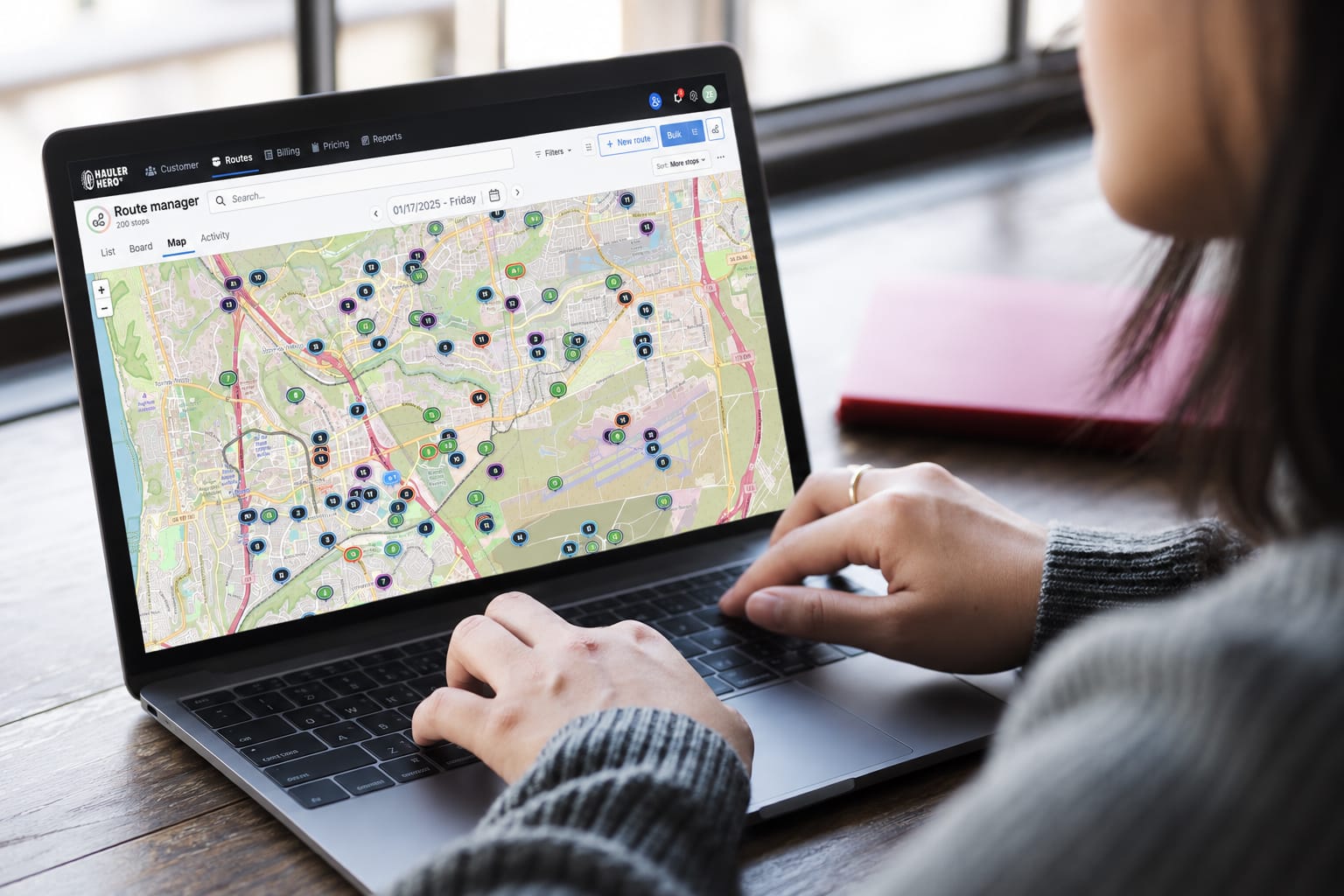
Your dispatchers know the routes. Hauler Hero gives them a live map, weeks of scheduled work, and tools to change it fast.
Trusted by Waste Haulers

















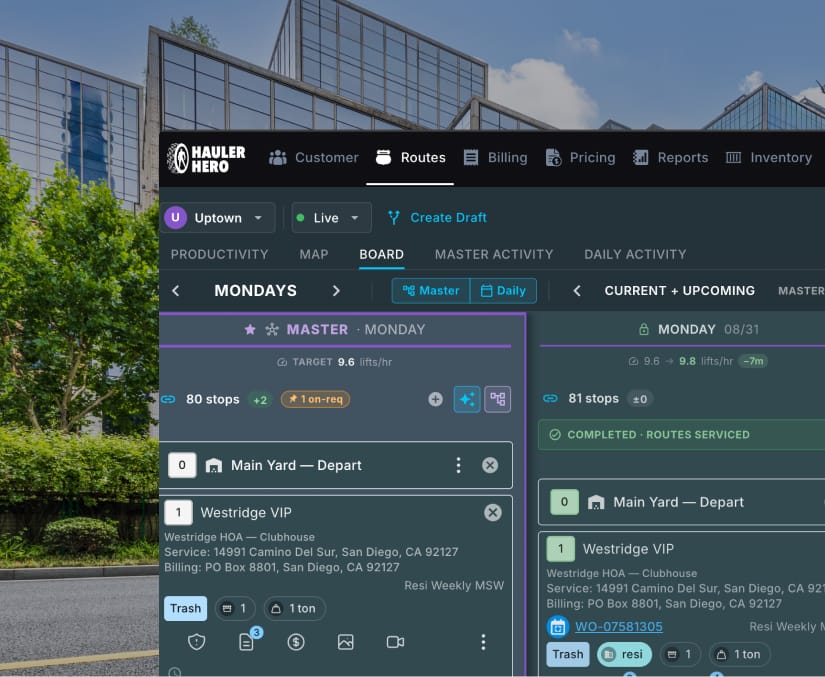
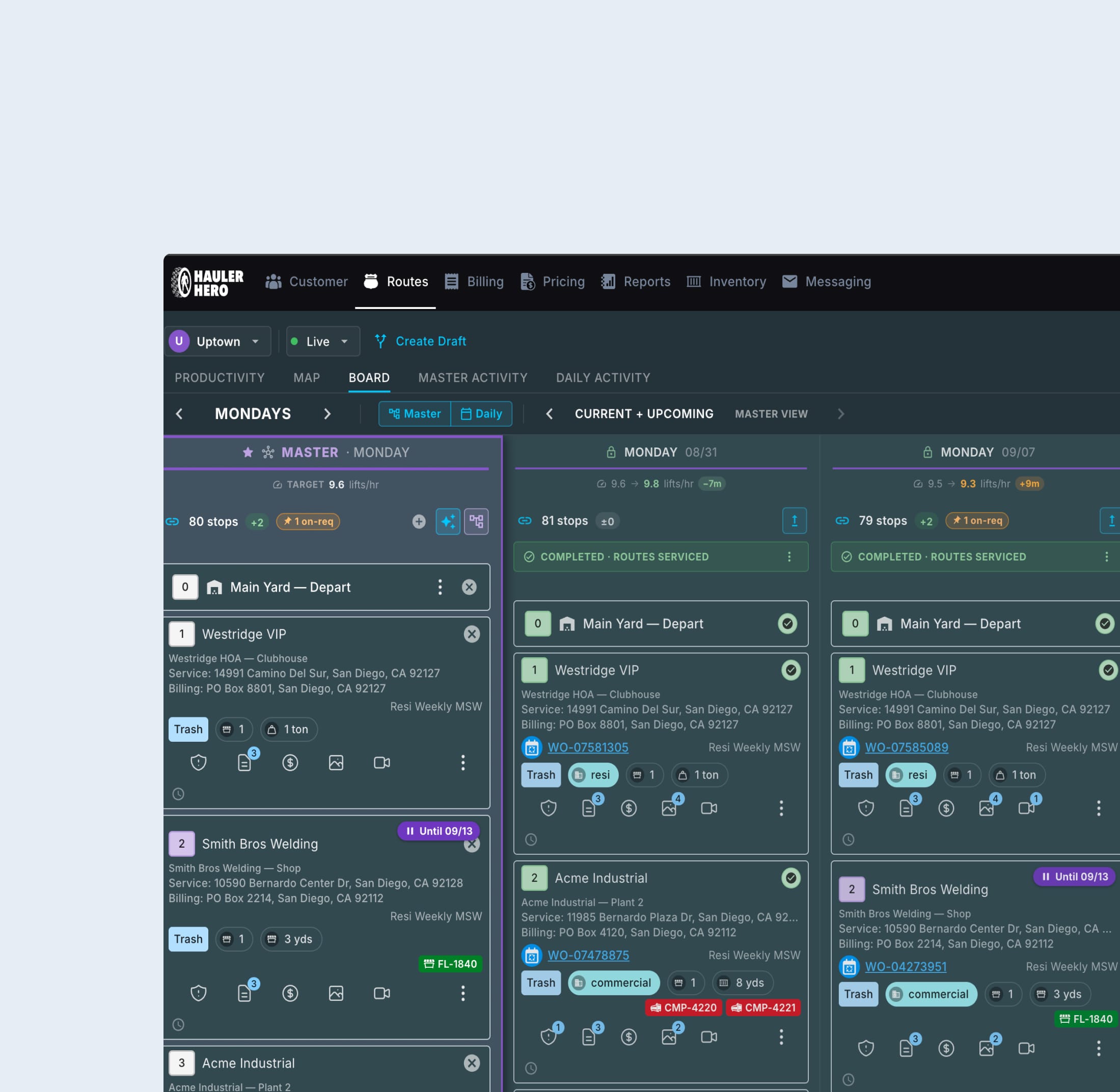
Master Sequence is the template your routes generate from, ten weeks out. Change it once and every future week follows. No more rebuilding the board every morning just to get drivers their stops.
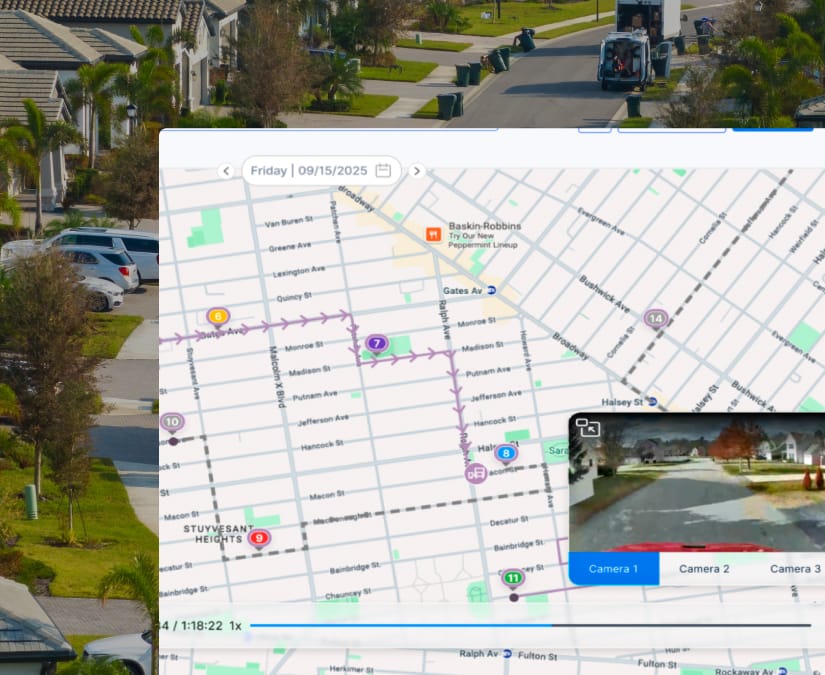
Live GPS tracking shows each truck’s location, stop status, and how much of the route is left. Dispatch knows a route is running behind before the phone rings, and can act on it from the same screen.
Here is what waste haulers are seeing since switching to Hauler Hero.

Saved per dispatcher
Annual value recovered per truck
The tool dispatchers use to build routes, keep them current, and move work when the day changes.
Every route runs off a master template that holds weekly, biweekly, monthly, and other mixed frequencies together. Edit the sequence once and Hauler Hero applies it to every week it generates. Routes schedule ten weeks out, so dispatch works ahead instead of resubmitting daily.
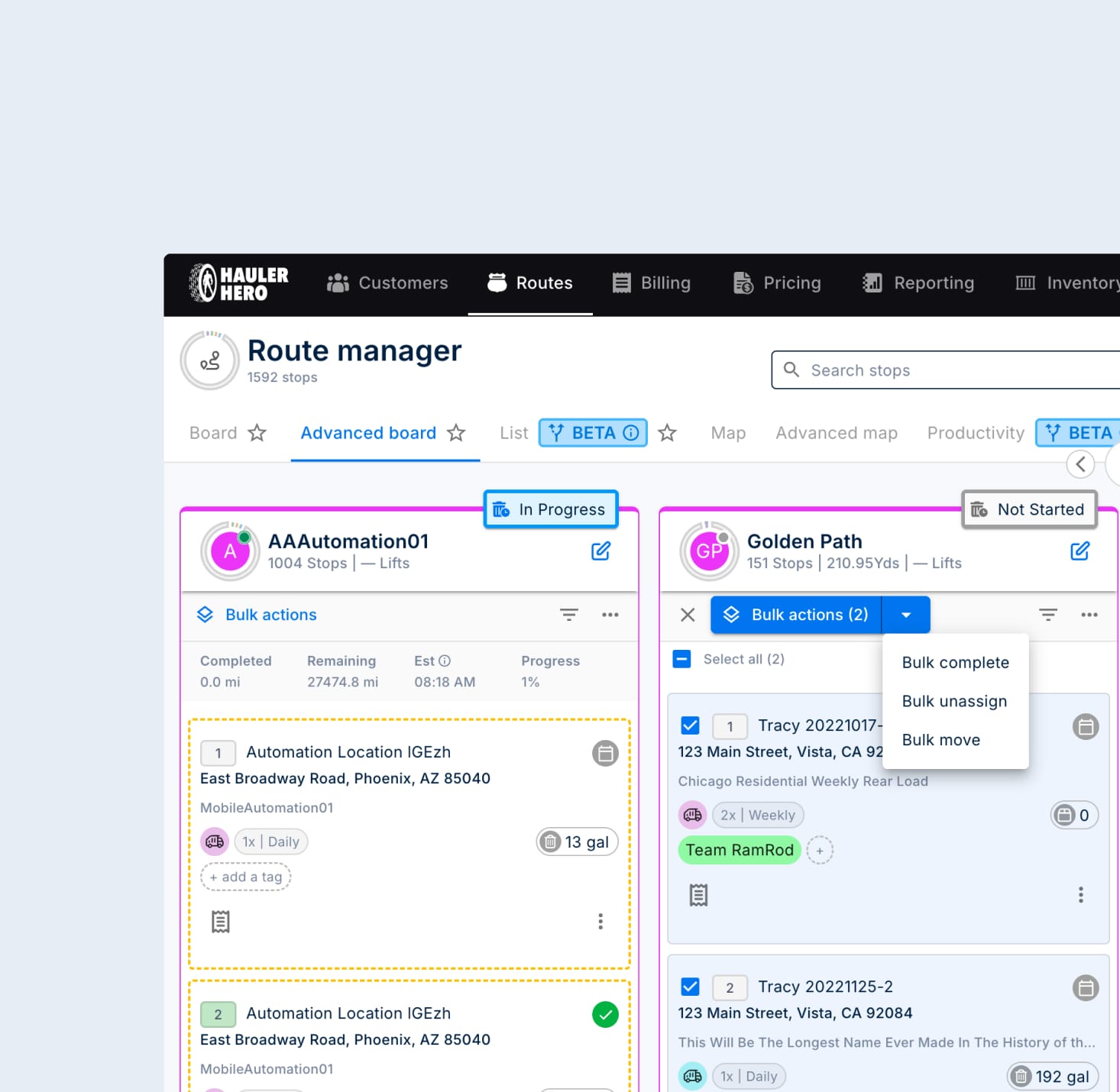
Lasso a group of stops on the map and move them to another route, another truck, or another day. Preserve the existing sequence, and save the change permanently or for a single day. Getting a helper route out or covering a breakdown takes minutes, not a morning.
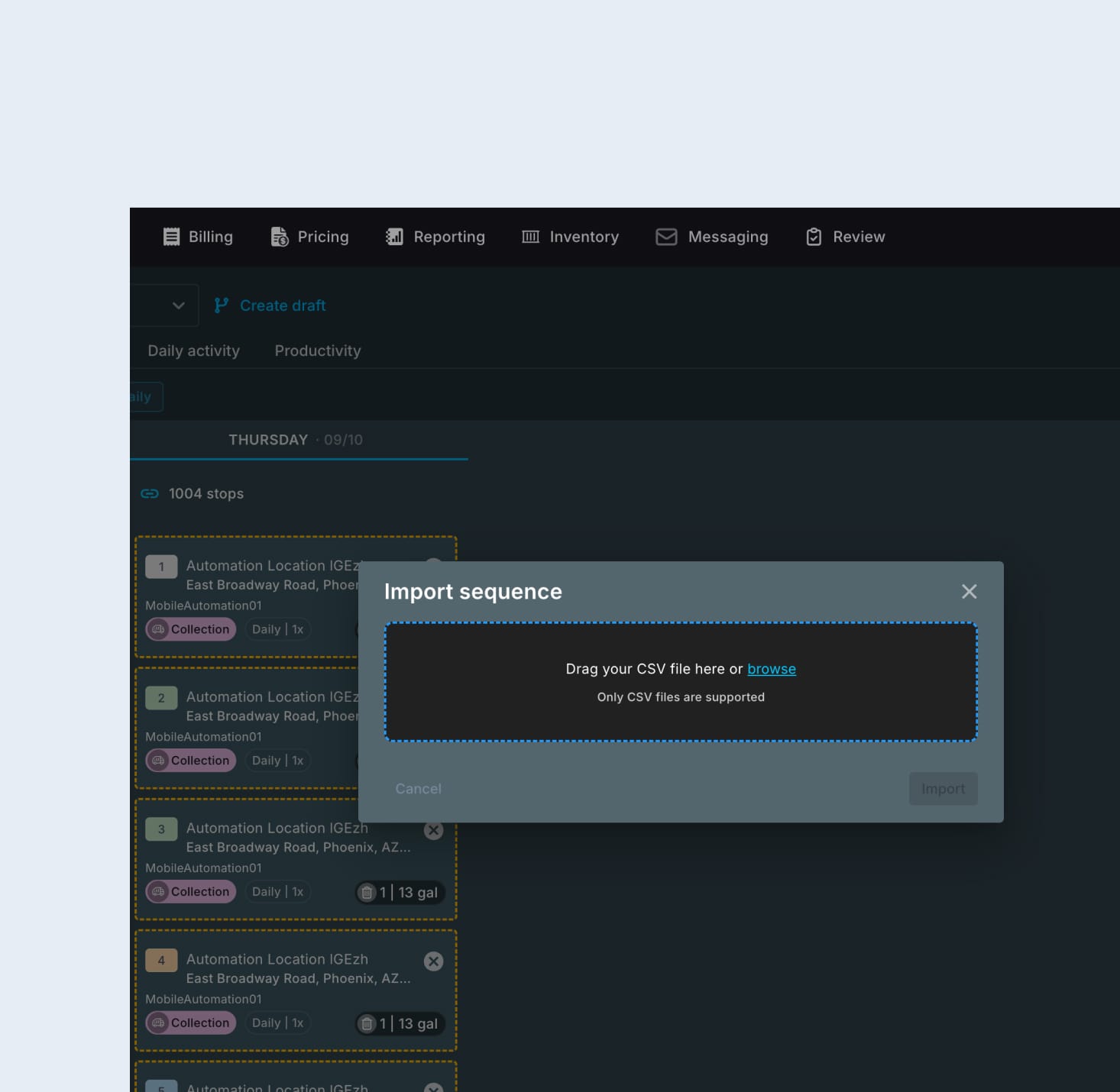
Resequence stops by hand on the map and publish the change forward. Import the order your driver already services them in, captured from Autocomplete, or bring a sequence in from a spreadsheet. Hauler Hero can also order stops by road distance from your yard as a starting point.
Setup

Your dedicated implementation team handles data migration, configuration, and setup from day one.
Training
Live training sessions, a full knowledge base, and video tutorials so your team gets comfortable fast.
Support
Our customer success and support team stays with you well after go-live — not just through launch.
How dispatchers build, sequence, and change routes in Hauler Hero.
Waste management routing software builds and maintains collection routes, sequences the stops on them, pushes them to drivers, and tracks what happens in the field. Hauler Hero is built for waste specifically, so
recurring service, mixed service lines, and route-based billing are native rather than adapted.
Hauler Hero includes a route sequence optimization tool that orders stops by road distance from your starting and ending yard. It is a fast way to bring a disorganized route into a workable order. It does not account for one-side-
only collection, dump runs, or truck capacity, so most operations use it as a starting point and adjust from there. A more advanced optimization tool is in development.
Yes, and for most established routes this is the better path. Hauler Hero can build the sequence from your driver’s tablet activity, capturing the order they already run, or import a sequence from a spreadsheet. That order then becomes the template every future week generates from.
Immediately. Changes made in the Route Manager sync to driver tablets as soon as you save. There is no reprint, no phone call, and no gap between what dispatch sees and what the driver’s app shows.
Yes. Hauler Hero does not restrict service types by route. Residential stops, commercial stops, and roll-off actions can sit on the same route wherever that makes operational sense, and each still bills on its own terms.
Yes. Completed stops and logged exceptions flow from the route into the billing queue. A skipped stop or an overloaded container is documented and available for review before an invoice goes out, so nothing bills incorrectly because operations and billing were looking at different records.
